In Short
- Tie every integration to a business outcome with an owner and a number.
- Sort connections into foundations, quick wins and later items, and mix the first two.
- Decide the platform approach once, and keep a one-page catalogue of live connections.
- Budget for run costs and review the plan every quarter.
One integration is a project. Ten integrations without a plan is a web of dependencies that nobody can change safely. A strategy decides what you connect, in what order, on which platform and who looks after it. If you want a partner to build that plan with you, start with my team's technology integration consulting.
This guide covers the choices that make up an integration strategy: outcomes, a portfolio view, platform choice, governance, funding and a three-horizon plan. It is written for the person who has to explain to the leadership team why the next twelve months of connections are ordered the way they are.
Start With the Business Outcomes You Want to Move
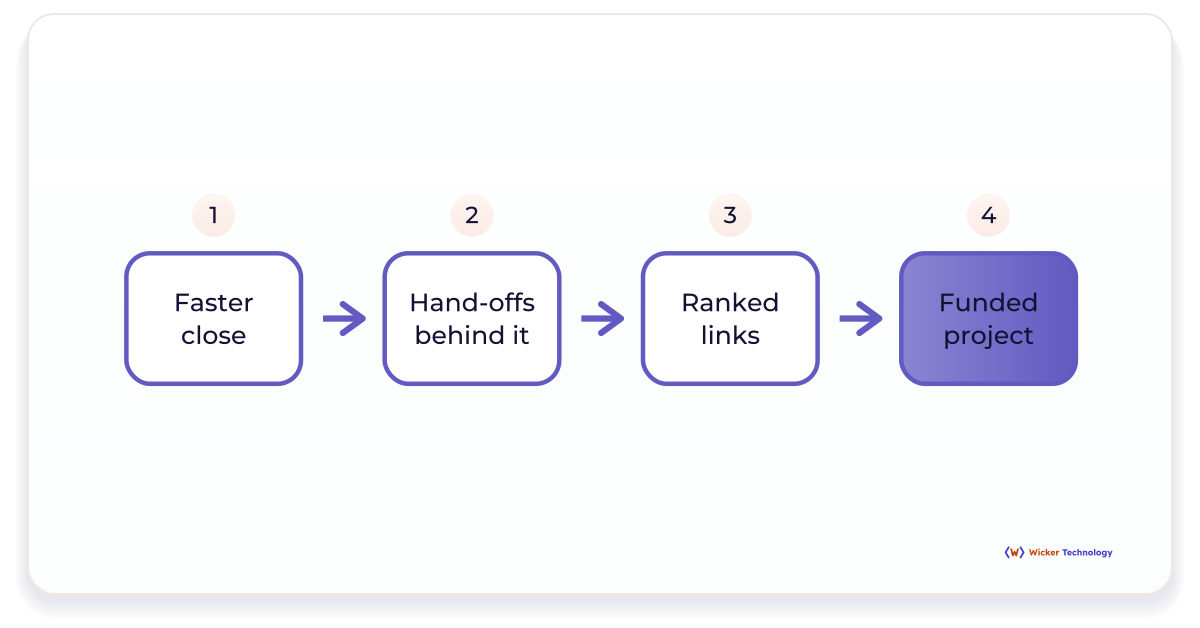
List the outcomes that depend on systems sharing data: faster month-end close, one customer view, same-day order status, fewer duplicate entries. Attach a number and an owner to each. An outcome without an owner has no one to ask whether the integration worked.
Then connect each outcome to the hand-offs behind it. Month-end close, for example, may depend on three connections: sales to billing, billing to the ledger and bank feeds to cash. This turns a vague aim into a short list of candidate connections that you can score. If you need a method for scoring, the technology integration framework describes one.
Treat Connections as a Portfolio
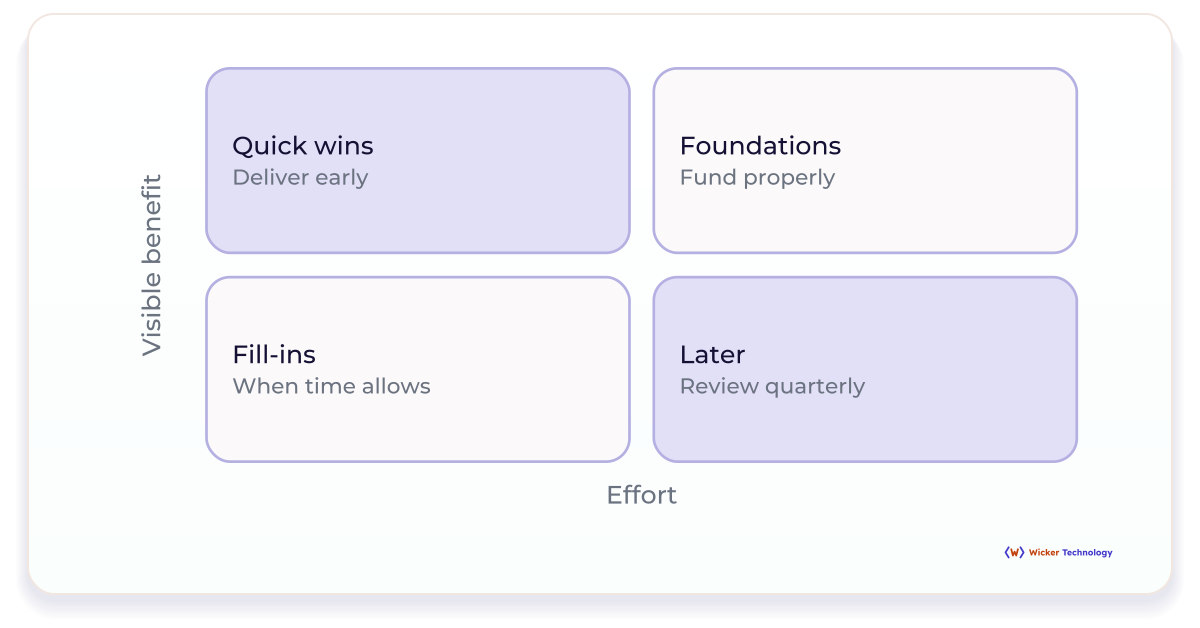
Look at all candidate connections together and sort them in three groups: foundations, quick wins and later. Foundations are connections that many others depend on, such as a customer master record. Quick wins are cheap and visible. Later items wait for a decision or a dependency.
| Group | Typical traits | How to treat it |
|---|---|---|
| Foundations | Many systems depend on it; takes longer; needs clear ownership | Start early, fund properly, protect from scope changes |
| Quick wins | Two systems, clean data, visible benefit within weeks | Deliver first to build trust and free staff time |
| Later | Needs vendor change, data work or a policy decision | Keep on the list, review every quarter |
A common mistake is to start only with quick wins. They are pleasant, but if the foundation is missing, each quick win is built on a different definition of a customer. Mix them: one foundation and one or two quick wins in the first half year.
Decide Your Platform Approach Once
Teams that decide platform by project end up with five different tools and five sets of skills. Decide the approach at strategy level and apply it to every project, with exceptions that need a reason.
| Approach | Works well when | Avoid |
|---|---|---|
| Direct connections | You have a few systems with good vendor APIs | Many one-off links that nobody can see together |
| Integration platform or middleware | You connect many systems or need central monitoring | Licence cost and a skills requirement |
| Vendor-built connectors | Both vendors are mainstream and support the pair | Limits when you need custom rules |
| Mixed | You have both simple and complex flows | Needs a clear rule on which to use when |
Your choice depends on volume, skills and how fast your systems change. If you have fewer than five systems, direct connections with good monitoring may serve you for years. Beyond that, a central layer tends to pay for itself. The technology integration best practices cover standards that apply whichever you choose.
Governance That Fits on One Page
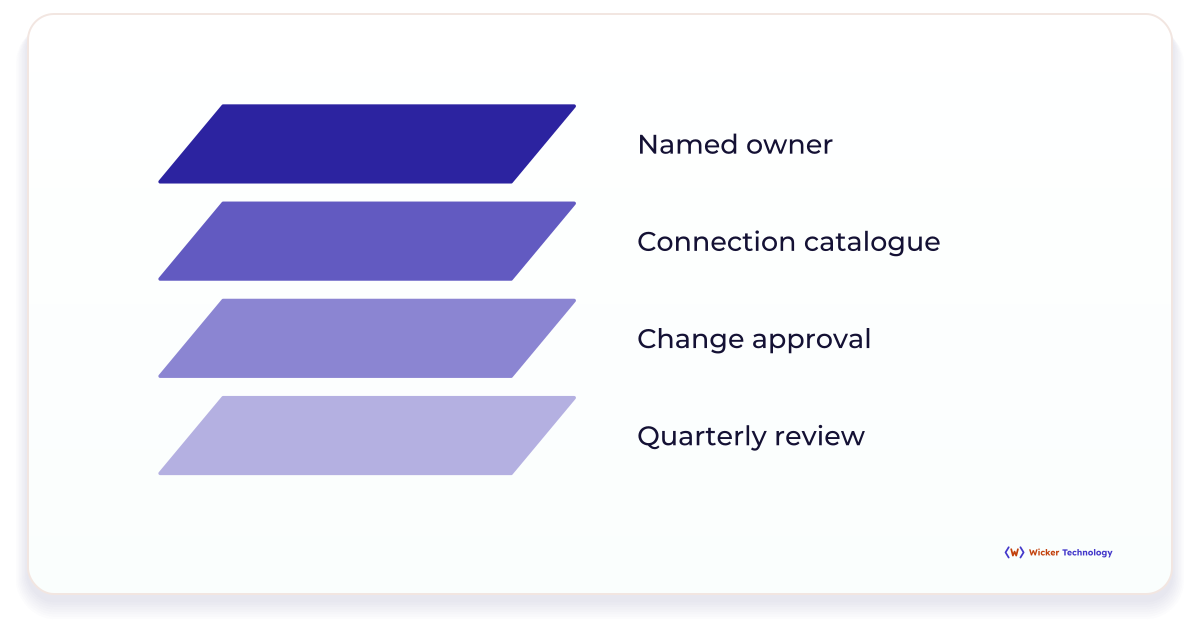
Governance sounds heavy, but a small version is enough. Define who may request a new connection, who decides priority, who approves changes to data ownership and who owns each live connection. Hold a short monthly review of health, open requests and upcoming vendor changes.
Keep a catalogue of connections with the owner, purpose, data, version and alert contact. This is the single most useful artifact an integration strategy produces. It makes upgrades routine and turns "who knows how this works?" into a lookup.
Fund Run Costs, Not Just Build Costs
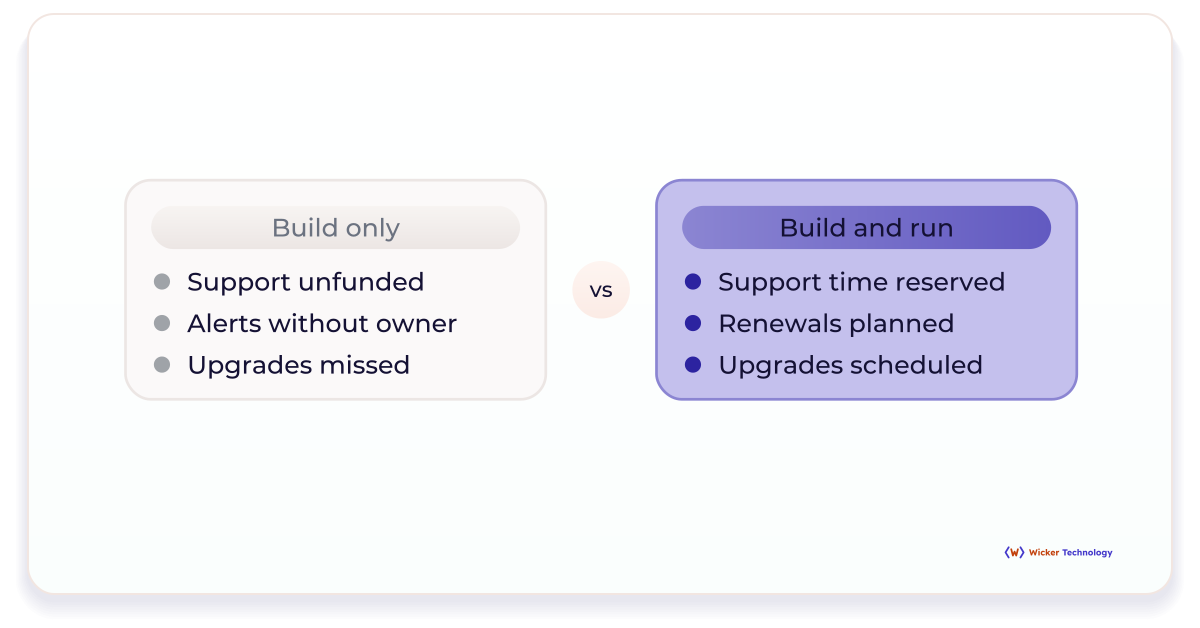
Each connection costs money after go-live: licences, monitoring, fixes after vendor updates and a share of someone's time. Teams that budget only for the build discover the run cost the first time a vendor changes an API.
A rough planning habit: reserve a fixed share of the build cost per year for run and change, and review it after the first year. Treat the percentage as your own to calibrate, since it depends on how often your vendors change. The point is to have a line item that exists.
A Three-Horizon Plan You Can Show Leadership
Show the plan as three horizons rather than a precise Gantt chart. The first is committed, the second is likely and the third is directional. That keeps expectations honest and lets you adjust as vendors and priorities change. For turning the first horizon into dated milestones, see the technology implementation roadmap.
| Horizon | Time frame | Content | Confidence |
|---|---|---|---|
| 1 | 0 to 6 months | One foundation, one or two quick wins, monitoring and catalogue in place | High, with owners and budget |
| 2 | 6 to 18 months | Further connections from the ranked list, platform decision applied | Medium, reviewed quarterly |
| 3 | 18 months and beyond | Retire legacy links, consolidate tools, extend to partners | Directional |
Review the plan quarterly. Drop what no longer matters and move up what has become urgent, for example after an acquisition or a vendor retirement. The scenarios in the technology integration examples show how others sequenced their first horizon.
Measures That Show the Strategy Works
Pick a few numbers and report them every quarter: hours spent on manual hand-offs, error or rework rate, time from event to visibility across systems and the number of connections with a named owner and alert. Fewer than five is better than a dashboard nobody reads.
Record the baseline before the first project. Without it you cannot show the change, and the strategy becomes an argument instead of a result. Also track the risks that you expect to stall the plan, which the guide to technology integration challenges lists in detail.
Strategy Mistakes I See Most Often
Three mistakes account for most weak integration strategies. The first is writing a technology wish list and calling it a strategy. A list of systems to connect says nothing about order, funding or owners. The second is choosing a platform before the outcomes are known, so the platform shapes the priorities instead of the other way round. The third is treating the plan as fixed. Vendors change, acquisitions happen and priorities move, so a plan that is never reviewed becomes fiction within a year.
A quick test: ask someone outside IT to explain why the first connection on your list comes first. If they cannot answer in two sentences with a business reason, the strategy has not yet been communicated or has not yet been decided.
A Worked Twelve-Month Plan for a Mid-Sized Distributor
Take a distributor with an ERP, a warehouse system, a CRM, a billing tool and a carrier portal. Its main outcomes are faster order-to-cash and one view of each customer.
In the first quarter the team builds the catalogue, agrees ownership of customer and product records and builds the customer master connection, which is the foundation. In the second quarter it delivers the order-to-warehouse connection as a quick win and adds monitoring for both. The third quarter brings the carrier integration, using a translation layer so each new carrier is a mapping. In the fourth quarter it connects the CRM to billing and reviews the first year: hours saved, error rate and the cost of run and change.
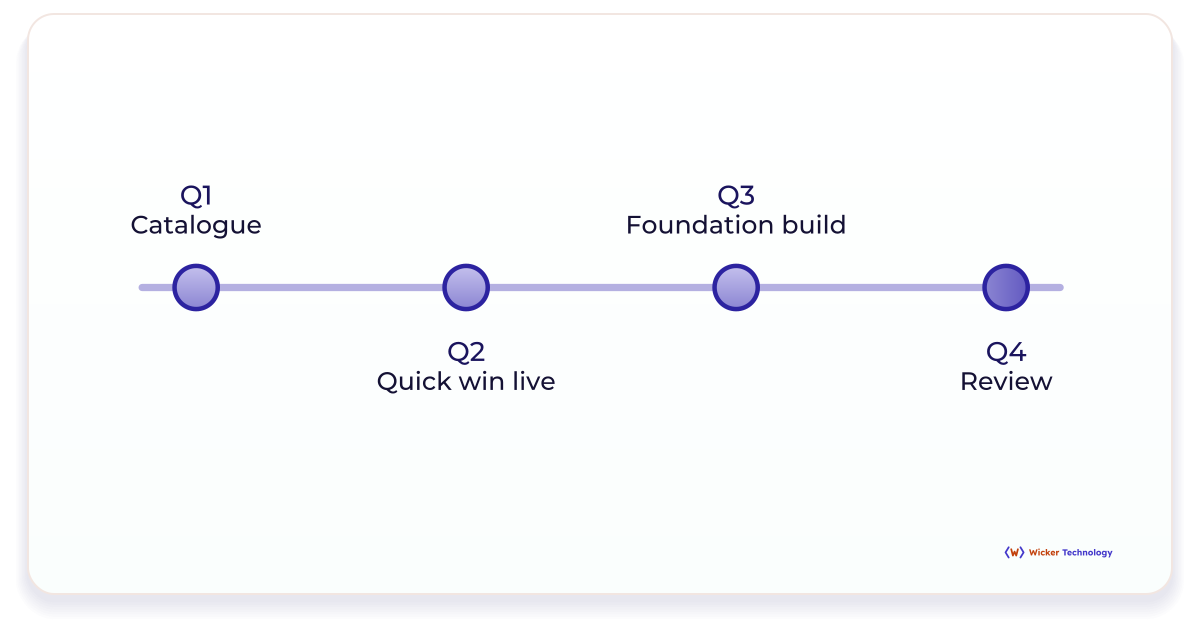
The plan fits on one page, each quarter has an owner and the platform choice is applied once. When a vendor retires an API in month eight, the team already has the catalogue entry and the monitoring to see the impact.
Risks to the Strategy Itself
Even a good strategy can fail for reasons outside the connections. A key sponsor leaves, a major vendor is acquired, a budget is cut halfway through the year. List the three most likely events and decide in advance what the plan does in each case.
For a lost sponsor, the answer is usually a second named sponsor and a plan that every executive has seen. For a vendor acquisition, it is the catalogue and the version list, which tell you immediately what is affected. For a budget cut, it is the ranked portfolio, which shows what to pause without breaking a foundation.
These decisions take an hour to write down and spare you a crisis meeting later. They also show leadership that the strategy is a working tool and not a slide. Review the list at each quarterly check, because the likely events change as your business and vendors change.
It is worth saying plainly that none of this requires a large team. A one-page strategy that is reviewed every quarter beats a forty-page document that is read once. Write for the person who will pick it up in a year, and include the reasoning behind each priority, so they can tell whether the reasons still hold when conditions change.
Also keep a short log of decisions with the date and the reason, such as why a platform was chosen or why a connection was postponed. When priorities change, the log shows what was assumed at the time and saves debates about history.
How to Choose Your First Moves
If you can only do three things this quarter, pick these:
- Write down the outcomes and attach an owner and a number to each.
- Build the catalogue of existing connections, even if it is incomplete.
- Choose one foundation connection and one quick win and fund them with a run budget.
Those three moves create the visibility that every later decision depends on. If your integrations are part of a larger change, align them with your technology implementation strategy and the technology transformation strategy.
Questions About Technology Integration Strategy
What Should a Technology Integration Strategy Include?
Business outcomes with owners, a portfolio of candidate connections, a platform approach, a governance model, funding for build and run costs and a plan in three horizons. A catalogue of live connections is the most useful working document it produces.
How Is an Integration Strategy Different from an Integration Framework?
The strategy decides what to connect, in which order and on which platform. The framework describes how to deliver each single connection. The strategy picks the next item and the framework delivers it.
Should I Buy an Integration Platform?
It depends on how many systems you connect and how fast they change. With a handful of well-documented systems, direct connections can be enough. Beyond that, central monitoring and reusable connectors usually pay off.
How Do I Fund the Run Costs of Integrations?
Add a yearly run and change budget as a share of the build cost, then adjust after the first year based on how often vendors change their systems. The aim is to have a line item, not to guess the perfect percentage.
How Often Should the Strategy Be Reviewed?
Quarterly. Drop items that no longer matter, move urgent ones up and check the first horizon against delivery. Review it also after an acquisition or when a vendor retires a product.
Which Connections Should Come First?
A foundation that many others depend on, such as a shared customer record, plus one or two cheap, visible quick wins. Quick wins alone often rest on different definitions of the same data.
How Do I Show Leadership the Plan?
Use three horizons: committed, likely and directional. Link each item to a business outcome and report a few numbers every quarter, including the baseline you measured at the start.
Important: nothing in this article is legal, financial or tax advice. All figures are estimates from typical projects, so verify them with your own providers and advisers.
Was this useful?
We appreciate the feedback.
Paige Mulvaney
Paige leads the Wicker editorial team and works with the consultants who run the roadmaps, software selections, implementations and integrations to turn real client projects into practical guides. Her focus is plain-language advice on IT strategy, choosing business software and connecting systems so they work together. Every article she edits is checked against current vendor pricing and documentation before it is published.