In Short
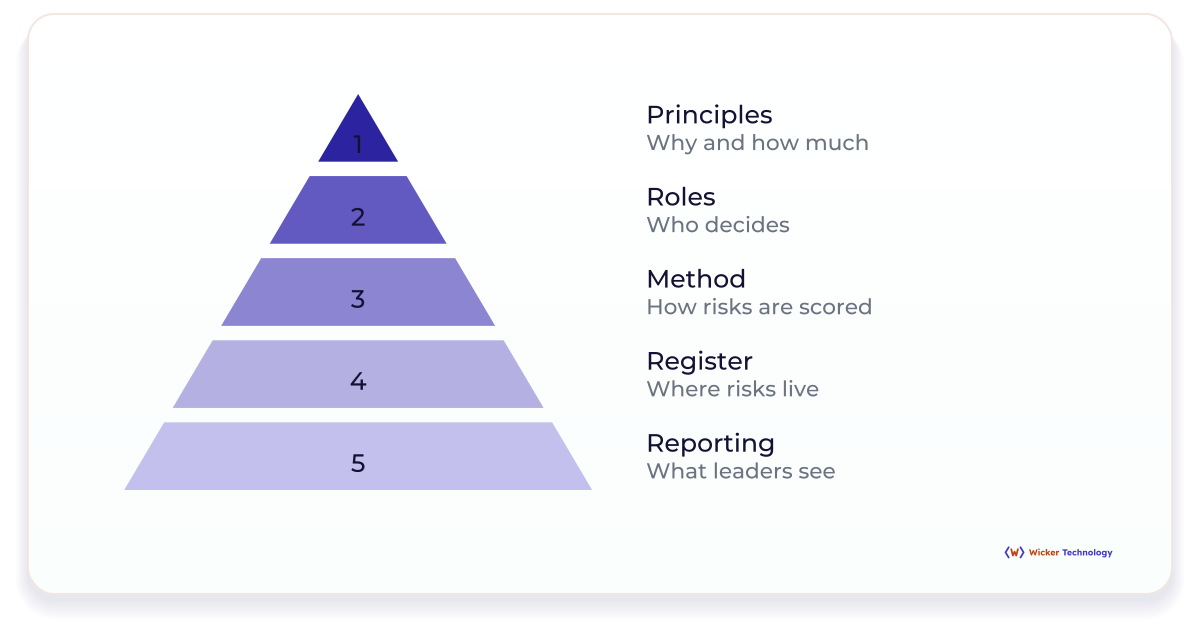
- A technology risk framework has five layers: principles, roles, method, register and reporting.
- Start with the smallest version that works, and add structure only when a pain point calls for it.
- The risk appetite statement is the layer most teams skip, and it is the one that settles arguments.
- Frameworks fail when they outgrow the people who run them, so match the design to your capacity.
A risk register is a list. A framework is what makes the list trustworthy: the agreements on who owns a risk, how it is scored and when it is reviewed. Without one, each team scores differently, and leadership cannot compare a billing risk with a security risk.
This blueprint shows five layers that I use when I set up programs in technology risk consulting. It is meant to grow with you, so each layer has a small version for a first year and a larger version for later.
The Five Layers Summarized
| Layer | What it defines | Small version | Larger version |
|---|---|---|---|
| 1. Principles | Why you manage risk and how much you will accept | Half a page and a few rules | Board-approved policy and appetite by area |
| 2. Roles | Who owns the program, each risk and each decision | Program owner plus risk owners | Risk committee, owners and an independent reviewer |
| 3. Method | How risks are found and scored | One 1 to 5 scale and a definitions page | Separate scales per area, quantitative scoring for top risks |
| 4. Register | Where risks live and what is recorded | A spreadsheet with ten columns | A GRC tool with workflows and history |
| 5. Reporting | What leadership sees and when | One page each month | Dashboards, quarterly board report and audit pack |
Build from the top down, in order. The first two layers take a few days and settle most of the arguments, since they decide who is allowed to decide.
Layer 1: Principles and Risk Appetite
Write down three to five principles. For example: every risk has one owner, risks are scored on one scale, accepted risks are signed by a named executive and the register is reviewed monthly. These sound obvious, and in practice they end more arguments than any tool.
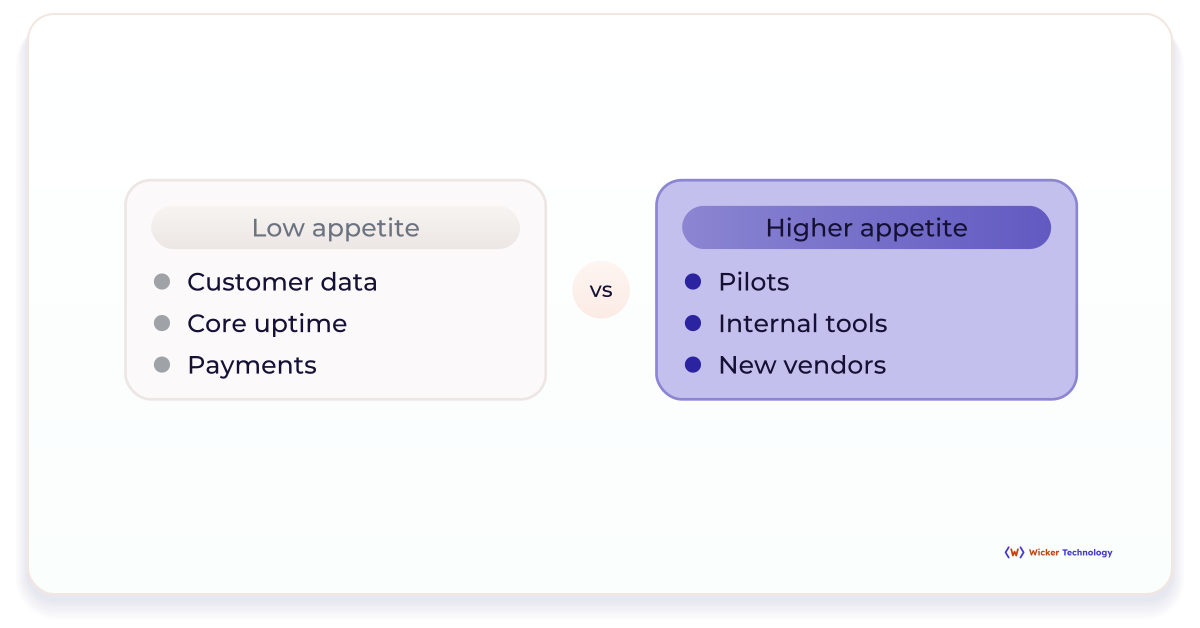
Then add a risk appetite statement. It states, in business terms, what you will and will not tolerate. A fitting example for a mid-sized company: no core system down for more than four hours, no software past end of support holding customer data and no single vendor holding more than a set share of critical services without an exit plan. Appetite makes scoring concrete. A risk above the line must be treated, and a risk below it can be accepted.
Layer 2: Roles and Decision Rights
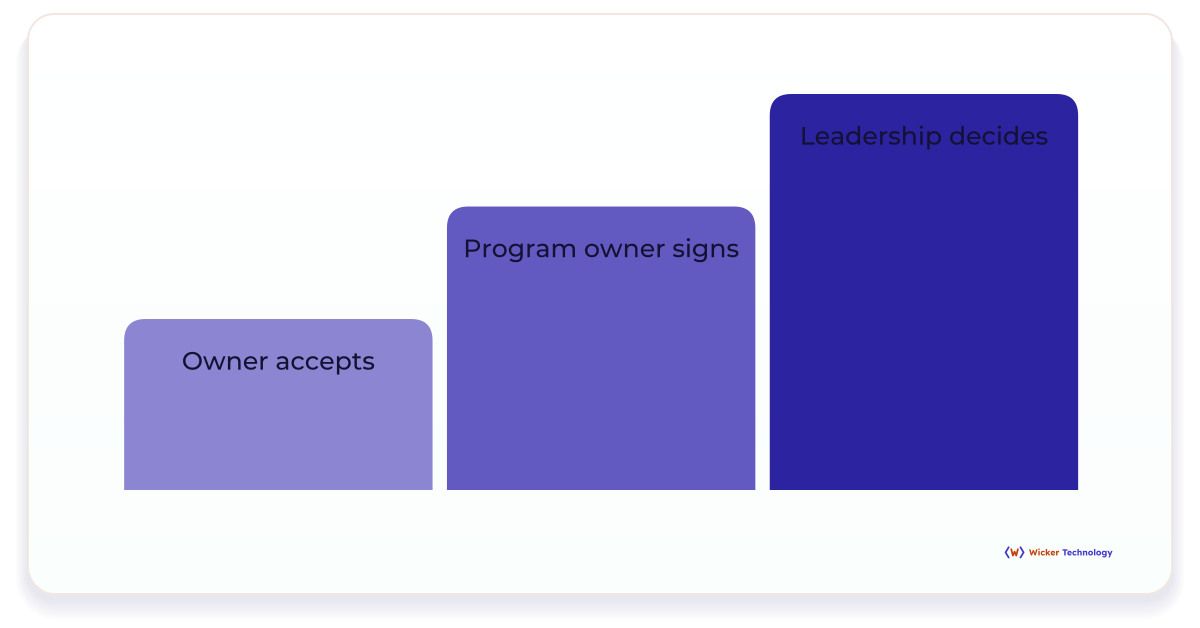
Name the program owner, the risk owners and the approvers. The program owner runs the cycle and keeps the register. Risk owners confirm the facts and deliver the fixes. Leadership approves anything accepted above a set score. In a small company, one person can play the first role and also advise on the second.
Put the approval thresholds in writing. A score under 8 might be accepted by the system owner, a score from 8 to 14 by the head of department and a score of 15 or more only by an executive. People respect thresholds when they save time, so keep them to three levels.
Layer 3: The Scoring Method
Choose a scale, define it and stick to it for a full year before you change it. A five-by-five grid is easy to explain. Define each level of likelihood in terms of time and each level of impact in terms of money, hours or customers. If you later add quantitative estimates for your top risks, keep the grid for everything else.
Keep the categories short. Six groups work for most organizations: operational, security, vendor, project, lifecycle and people. The categories help you spot patterns, such as too many vendor risks concentrated in one supplier. My guide to a technology risk assessment walks through using the scale on a real set of systems.
| Area | Example appetite rule | Typical trigger for review |
|---|---|---|
| Operational | No core system down for more than four hours | Any outage over one hour |
| Security | No known critical vulnerability open for more than 30 days | New scan results |
| Vendor | An exit plan for every vendor holding critical data | Contract renewal or acquisition |
| Project | No project over budget by more than 15% without review | Monthly project report |
| Lifecycle | No unsupported software on customer-facing systems | Support end date within 12 months |
Layer 4: The Register
A good register entry has ten fields: an ID, a risk statement, the category, the owner, likelihood, impact, score, treatment, target date and status. Add a field for the date of the last review. Anything more should earn its place.
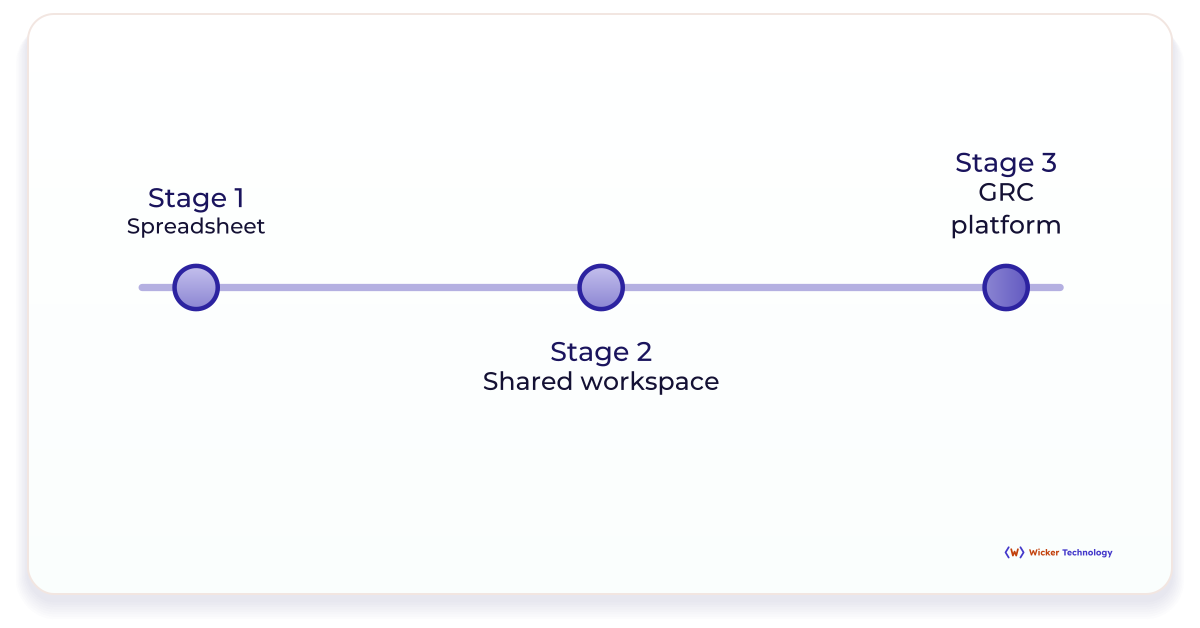
Keep it in a spreadsheet until it becomes a burden. The signs are clear: several people edit it at once, auditors ask for a history of changes or you need to link risks to controls. At that stage a tool helps, and the comparison in IT risk management software shows the main choices. Do not buy a tool to create a framework. Buy one to run the framework you already have.
Layer 5: Reporting That Gets Read
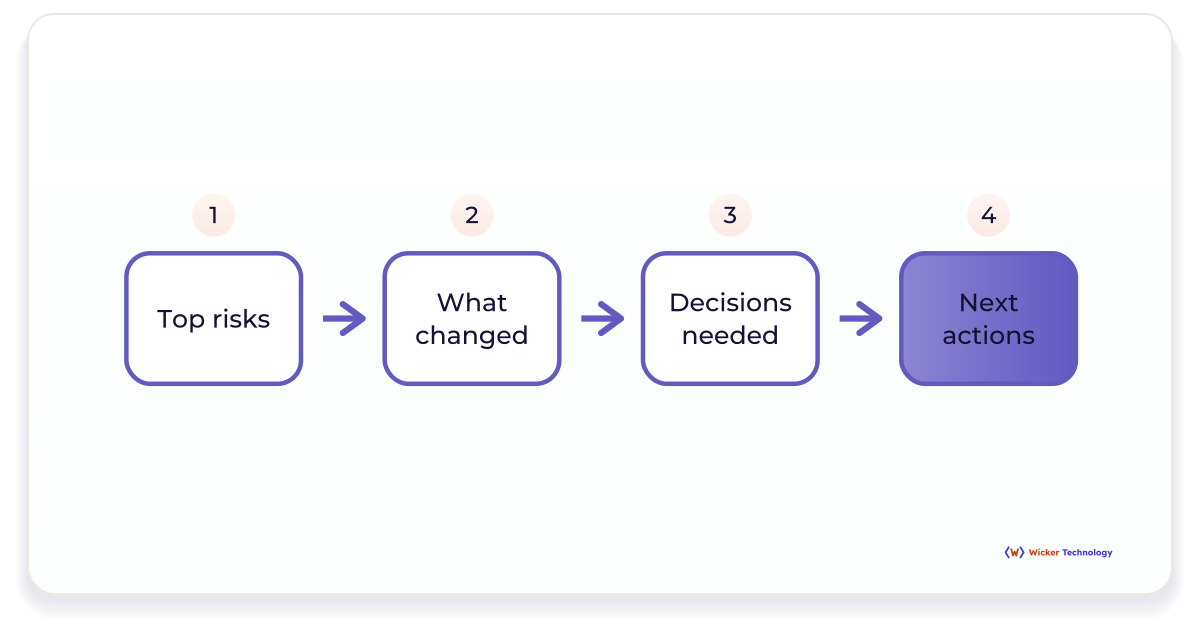
Leadership needs one page, once a month. It lists the top ten risks with their score and trend, the items closed since the last report, any risk that crossed the appetite line and decisions needed. Add a short paragraph of commentary written by the program owner in plain language.
For audits and insurers, keep an evidence folder: the framework document, the register with history, meeting notes and proof of completed fixes. Preparing that folder before you are asked turns an audit from a scramble into a routine, as I describe in my guide to a technology risk audit.
How the Framework Grows With You
A framework that fits 50 people will not fit 500. Plan the upgrades before you need them. At around 100 people, add a risk committee that meets quarterly. At around 300, add separate scales for security and operational risk and an independent reviewer. At several sites, add regional risk owners and common standards, so a risk in one location is reported the same way as in another.
The warning signs of outgrowing the framework are consistent: the register has hundreds of stale entries, owners skip reviews, scores are argued over every month or leadership stops reading the report. When you see two of those, simplify first and only then add structure. Looking at technology risk examples from other organizations helps you decide which structure to add.
Technology risk also connects with the wider operating model for technology. If you are building that too, my guide to technology risk management covers the monthly cycle that sits on top of the framework.
A Short Example of the Layers in Use
A regional healthcare group with about 400 staff adopted this blueprint over a quarter. The principles ran to one page. The appetite statement said that scheduling and records systems could not be down for more than four hours, and that no unsupported software could hold patient data. Leadership signed it after two rounds of edits.
The program owner was the head of IT, with one risk owner per core system. The scale was five by five, with definitions in time and money. The register started with 28 risks, and the first monthly review closed three and added two. Nine of the 28 sat above the appetite line, and those became the quarter's plan.
The report to leadership was one page. After two months, the COO started asking for the page before the monthly leadership meeting, which is a good sign: a report that people ask for is a report that works. The group did not buy a tool in the first year. It moved the register into software in the second year, when two more sites joined.
Mistakes to Avoid When You Build It
The most common mistake is copying a large standard wholesale. A 60-page policy written for a bank rarely suits a 200-person company, and nobody reads it. Borrow the vocabulary, such as identify, assess, treat and monitor, and write your own version in plain language.
The second is leaving out the appetite statement because it feels like a leadership task. Without it, every score is a negotiation. The third is building the register before the roles, so risks have no owners and the review has no chair. The fourth is a framework with no review date: it is written once, signed and forgotten. Put the first annual review in the calendar when you approve it.
A Ninety-Day Rollout Plan
You can have a working version of all five layers in a quarter. In the first month, draft the principles and appetite and name the program owner and the risk owners. In the second month, agree on the scale, build the register from the ten most important systems and score it. In the third month, hold the first monthly review, send the first one-page report and fix any scoring rule that caused arguments.
Expect a delay or two. Interviews slip, owners are on leave, and the appetite statement takes an extra round. Plan for it, and do not let the schedule push you into skipping the appetite discussion, because everything else depends on it.
One last point on timing. Revisit the whole blueprint once a year, with the same discipline as the register. Ask whether each layer still matches how the organization works, which roles changed and whether the appetite statement still reflects what leadership would accept today. A short annual review keeps the framework a living agreement and prevents it from becoming a binder on a shelf.
How to Choose the Right Size for Your Framework
Match the framework to your capacity to run it, not to the largest standard you can find. A smaller framework that runs every month beats a larger one that runs twice a year. Check these four points before you finalize the design:
- The program owner can explain it in ten minutes.
- Leadership has signed the appetite statement.
- The register fits on a screen when you filter for the top ten.
- The monthly review is already in the calendar for the next three months.
Questions About Building a Technology Risk Framework
What Is a Technology Risk Framework?
It is the set of agreements that make technology risk work repeatable: who owns what, how risks are scored, where they are recorded and how they are reported. It turns individual judgment into a shared method.
Do I Need to Follow a Standard Such as NIST or ISO 27005?
They are good references, and many auditors know them. You do not need to adopt one in full. Borrow the vocabulary and the cycle, and keep your own version short enough to run. Check the current versions of any standard you cite.
How Big Should the Framework Be?
Small enough that the program owner can explain it in ten minutes. For most organizations under 500 people, that means a five-page document, a register and a monthly review.
What Is a Risk Appetite Statement?
It is a short, written statement of how much risk leadership will accept, in business terms. Example: no core system may be unavailable for more than four hours, and no unsupported software may run customer data.
How Does a Framework Differ from a Risk Register?
The register lists the risks. The framework defines how the register is built, scored, reviewed and reported. You need both.
Who Approves the Framework?
Senior leadership approves the principles and the appetite. The program owner maintains the rest. Approval matters, because it gives the owner the authority to ask for updates.
How Do We Keep It from Turning into Paperwork?
Cap the register at the top risks, tie reviews to real events and report on one page. If the framework creates work that nobody reads, remove it.
Important: nothing in this article is legal, financial or tax advice. All figures are estimates from typical projects, so verify them with your own providers and advisers.
Was this useful?
We appreciate the feedback.
Paige Mulvaney
Paige leads the Wicker editorial team and works with the consultants who run the roadmaps, software selections, implementations and integrations to turn real client projects into practical guides. Her focus is plain-language advice on IT strategy, choosing business software and connecting systems so they work together. Every article she edits is checked against current vendor pricing and documentation before it is published.