In Short
- A business technology strategy fits on one to three pages and links every priority to a business goal.
- Five priorities cover most needs: customer data, reliable numbers, connection, protection and adoption.
- Score every request against your goals, buy before you build and sequence by dependency.
- Review the strategy each year and put the scoring form into your real request process.
A business technology strategy answers one question: what should technology do for this company over the next three years? It is not a list of products. It is a set of priorities, a way to decide between them and rules for how you will run what you buy. If you want help shaping one, business technology consulting can speed up the first draft.
I use the same structure with most clients: five priorities and a four-move playbook. This guide explains both, shows a one-page template and flags the traps I see most.
What a Business Technology Strategy Contains
A useful strategy fits on one to three pages and holds six things: the business goals it serves, the five or fewer priorities, the principles for decisions, the budget range, the risks you accept and how you will measure progress. Anything longer tends not to be read.
| Part | The question behind it | Example |
|---|---|---|
| Goals | What must the business achieve? | Grow revenue per employee, close books faster |
| Priorities | Where does technology help most? | Customer data, finance systems, security |
| Principles | How do we decide? | Buy before build, one system per job |
| Budget | What can we spend? | A range per year, split run versus change |
| Risks | What do we accept? | Slower rollout in exchange for lower disruption |
| Measures | How do we know it works? | Days to close, cost per transaction, uptime |
The Five Priorities Most Companies Need
The names change but the list is stable. The order depends on your business, so rank them against your goals.
1. Know Your Customers in One Place
If customer data lives in email, spreadsheets and three tools, sales, support and finance each see a different company. A single customer record, usually in a CRM, is the base for almost everything else. In my client work it is the first priority more often than any other.
2. Make the Numbers Reliable
Finance systems should close the books quickly and match the operational systems. If the monthly close takes over ten working days or relies on a spreadsheet only one person understands, put it near the top of your list.
3. Connect Systems Instead of Adding Them
Most companies have enough software. What they lack is connection. A priority on integration, with alerts for failed syncs, usually returns more than another application.
4. Protect What You Run
Access control, backups, patching and vendor review belong in every strategy. Pick a small set of controls and do them well rather than a long list done halfway.
5. Help People Use What You Own
Training, simple documentation and a clear place to ask for help turn software into results. Adoption is often the cheapest improvement available, and companies underfund it.
The Playbook in Four Moves
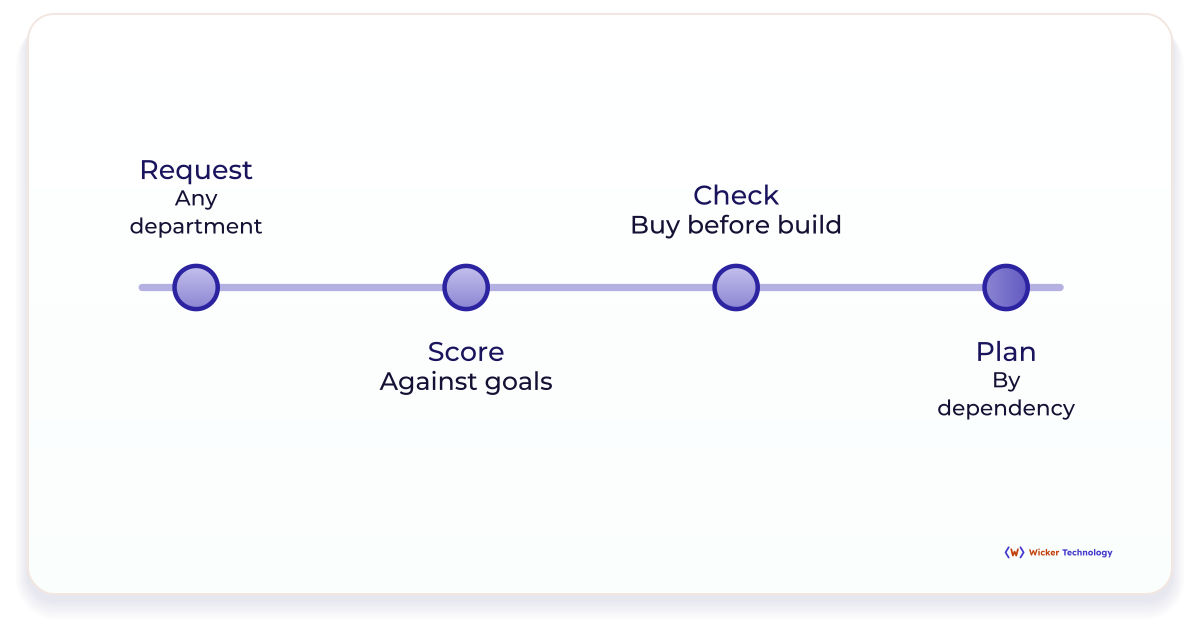
With priorities set, the playbook says how to act on them. I keep it to four moves that repeat each year.
Move 1: Score Every Request Against the Goals
Every request for a new tool or project gets a short form: which goal does it serve, what number moves, what does it cost over three years and who owns it. A request that cannot answer the first two questions waits. This one habit stops the pile of one-off tools that grows in most companies.
Move 2: Buy Before You Build
Custom software is a long-term cost. Buy a standard product unless the process is truly unique and gives you an edge. When a team asks for custom work, ask what a standard product would not do. The answer is often short. My ranking of business technology solutions is a good place to shortlist products for the usual jobs.
Move 3: Sequence by Dependency
Some projects make others easier. Clean customer data comes before a CRM upgrade. Single sign-on comes before adding many new tools. Order your work by dependency, then by payoff. The calendar form of this is a business technology roadmap.
Move 4: Run What You Own
Every system needs an owner, a review date and a plan for upgrades and exits. This is the daily side of business technology management, and it decides whether your strategy survives the first year.
What the Strategy Looks Like in Practice
A 150-person services firm I worked with set three priorities: one customer record, a faster close and a secure base. Its principles were buy before build and one system per job. Over 18 months it retired two overlapping tools, connected its CRM to billing and cut its close from 11 to 7 working days. Several of those steps appear in my collection of business technology examples.
It did not go smoothly. A planned data cleanup took twice as long as estimated, which pushed the CRM upgrade back a quarter. Because the strategy ranked the work by dependency, the delay moved one project instead of breaking the plan.
| Strategy choice | Benefit | Trade-off you accept |
|---|---|---|
| Buy before build | Lower cost, faster start | Less tailored fit |
| One system per job | Simpler support, cleaner data | Fewer best-of-breed features |
| Small set of priorities | Focus and finished projects | Some requests wait |
| Quarterly review | Plan stays current | Time from leaders each quarter |
How to Rank Your Priorities
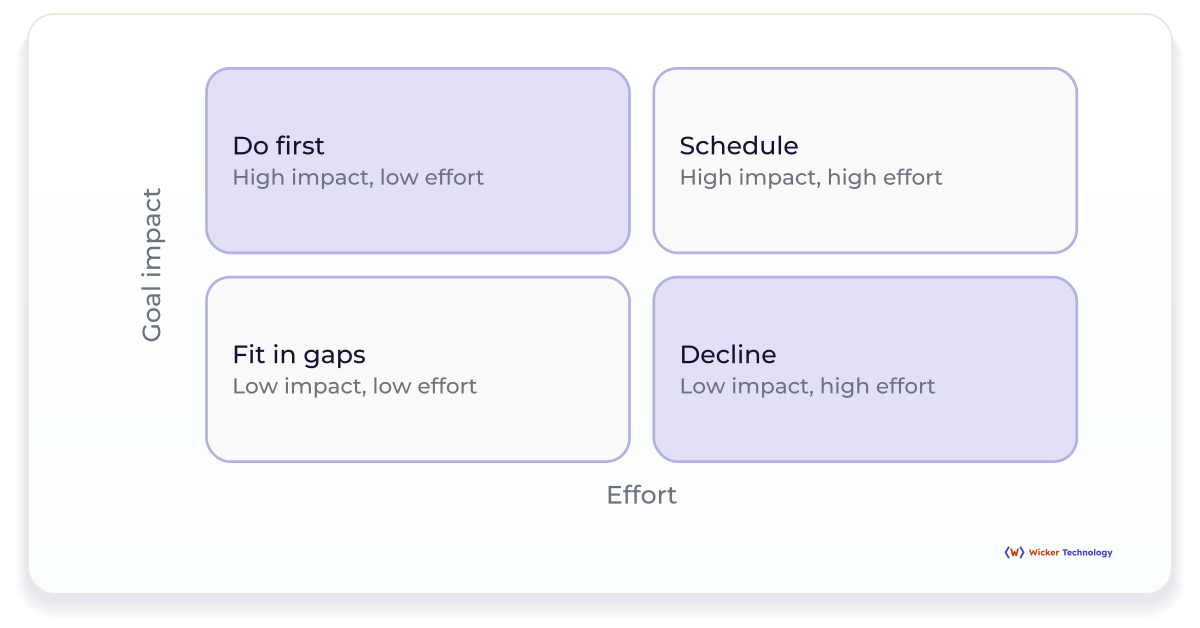
Do not rank by gut. Give each of the five priorities a score from 1 to 5 for three questions: how much does it affect your goals, how weak are you today and how ready is your team to act on it? Add the scores. The highest total goes first.
| Priority | Goal impact | Weakness today | Team readiness | Total |
|---|---|---|---|---|
| Customer data in one place | 5 | 4 | 3 | 12 |
| Reliable numbers | 4 | 5 | 4 | 13 |
| Connect systems | 4 | 3 | 4 | 11 |
| Protect what you run | 3 | 4 | 5 | 12 |
| Help people use it | 3 | 3 | 5 | 11 |
In this example, reliable numbers goes first, and customer data and protection tie for second. Ties are a good moment to look at dependencies: does one make the other easier? Here, clean finance data helps the customer record, so finance goes first.
Share the scores with your department heads. The disagreement is useful. If sales scores customer data a 5 and finance scores it a 2, you have found a conversation worth having before you commit budget.
How the Strategy Changes With Company Size
A 30-person company does not need the same document as a 500-person one. The shape stays, the weight changes. Here is how I adjust it.
| Company size | Focus | Typical owner | Review rhythm |
|---|---|---|---|
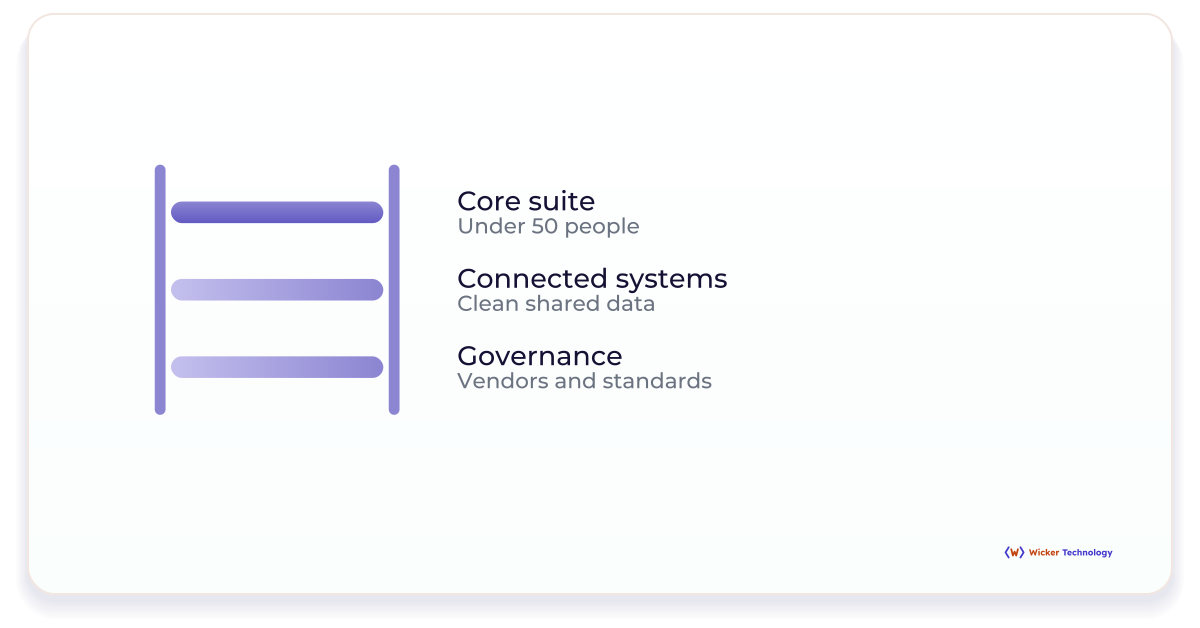
| Under 50 people | Pick a core suite, a CRM and accounting; keep things simple | Founder or office manager with an outside adviser | Yearly |
| 50 to 250 people | Connect systems, clean data, add security basics | IT lead or operations head | Quarterly |
| 250 to 1,000 people | Governance, vendor management, integration platform | Head of IT with a steering group | Quarterly, with a yearly rewrite |
In smaller companies the biggest risk is dependency on one person. If the IT lead leaves, can someone find the admin passwords and the contract list? Write that down first. In larger companies the risk is the opposite: too many hands and too many tools, so governance and a clear approval path matter most.
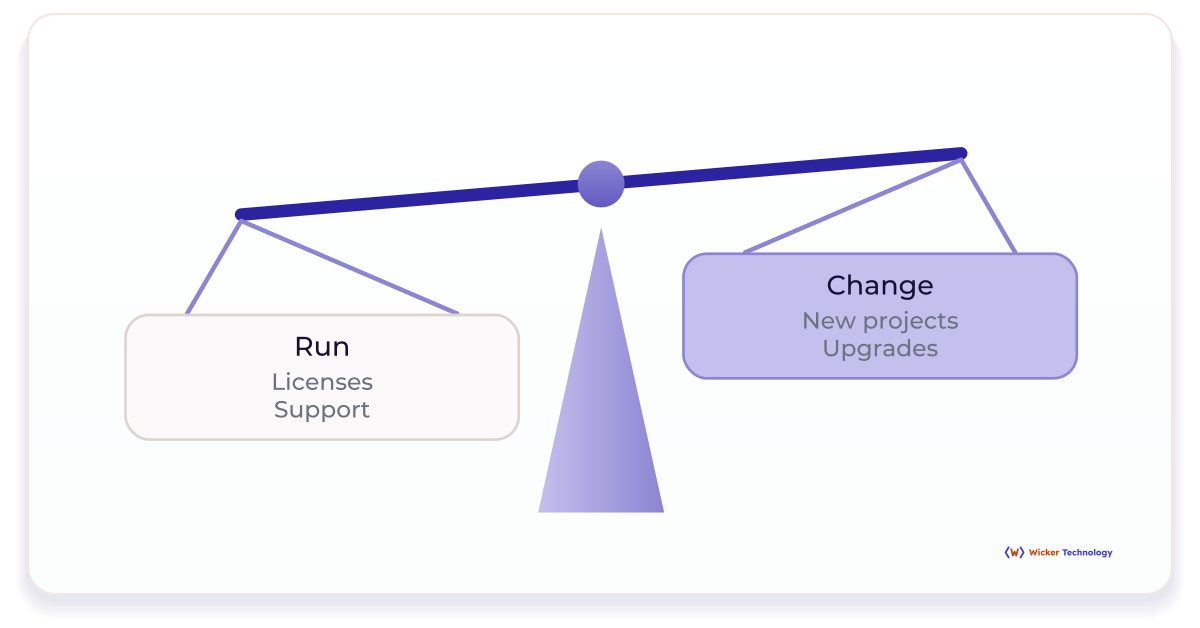
Whatever your size, link the strategy to money. Ask finance for last year's technology spend by category, split into run and change. In most companies that exercise alone surprises someone, and it gives the strategy a baseline you can improve against.
Traps That Weaken a Strategy
The most common trap is the product-led strategy: a document that is really a shopping list. It reads well for a quarter and then breaks when a vendor changes its pricing. A strategy states needs, and products are decided later.
The second trap is a strategy with no budget range. People read a document without numbers as a wish. Even a rough range, such as a split between run costs and change costs, gives the plan weight.
The third is a strategy written once and never reviewed. Businesses change, vendors change and your own team changes. A yearly review and quarterly check-in keep it honest. The fourth is skipping the people side. A good priority list needs time from busy employees, so ask for their time in the plan rather than assuming it.
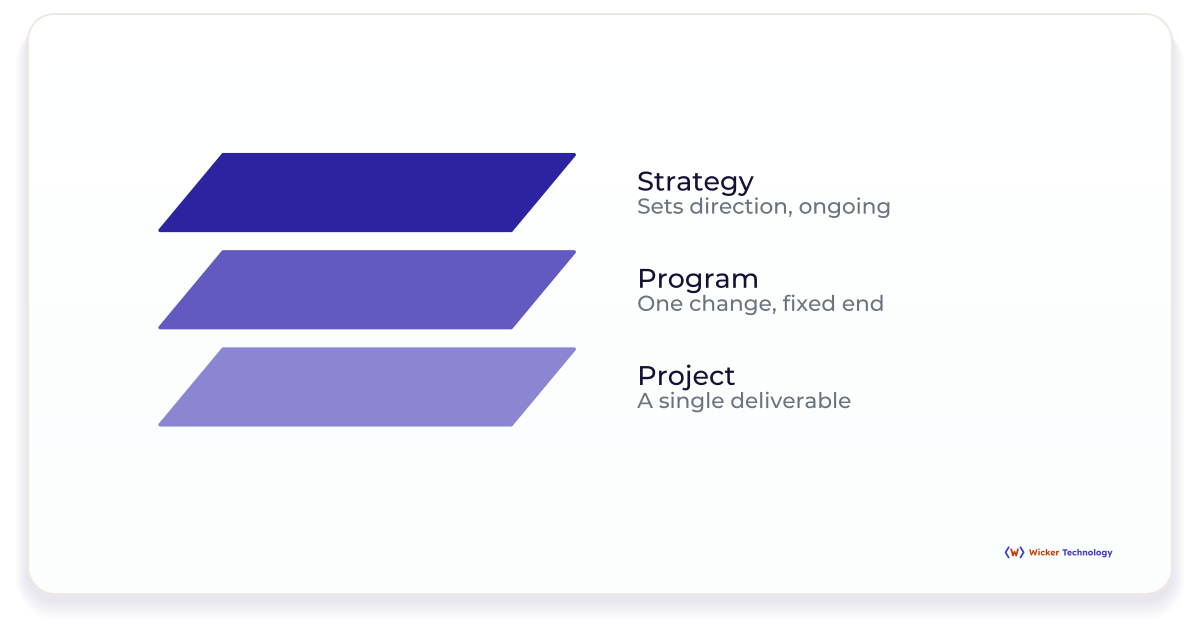
Finally, do not confuse a strategy with a transformation program. Most companies need steady improvement over several years, not a big-bang change. Small, finished projects build the trust that bigger ones need.
One more habit helps every strategy: write down what you will not do. A line such as "no custom software for finance in the next two years" saves hours of debate and protects the priorities when a persuasive vendor appears. Revisit the not-to-do list at each yearly review, and remove items only when the business case has truly changed.
How to Draft Yours This Month
You can write a first version in a week. Start with the business plan, list your goals, then rank the five priorities above against them. Write the principles, add a budget range and set three measures. Share it with department heads and ask what is missing.
- Are there five or fewer priorities, each linked to a business goal?
- Do you have a scoring form for new requests?
- Does every system have an owner?
- Is there a budget range and a review date?
If you answer no to more than one, draft those parts first. A rough strategy used every week beats a polished one nobody opens.
Questions About Business Technology Strategy
What Is a Business Technology Strategy?
It is a short document that sets technology priorities, decision rules, budget and measures in line with your business goals. It guides which projects you start and which you decline.
How Is It Different from an IT Strategy?
An IT strategy often focuses on infrastructure and the IT department. A business technology strategy starts from business goals and covers every team's systems, including those that sales, finance and operations buy themselves.
How Long Should the Strategy Be?
One to three pages. Longer documents tend to go unread. Put detail in appendices such as the system inventory and keep the main document readable in ten minutes.
How Often Should I Update It?
Review it each year and check progress each quarter. Update it when your business goals change, you acquire a company or a major vendor contract ends.
Who Should Write It?
The head of IT or operations usually drafts it with input from department heads, and an executive sponsor approves it. An outside consultant can speed up the first draft and bring comparisons from other companies.
How Much Should I Budget for Technology?
There is no single right share of revenue, because it varies by industry and by how much you run versus change. Set a range based on last year's spend, split it into run and change, and test it against your priorities.
How Do I Stop Shadow IT?
Make it easy to ask for tools and fast to get an answer. Use a short scoring form, run an annual software review and show teams the approved options. Banning purchases without offering a path usually drives them underground.
Disclaimer: This article is general information, not legal, tax or financial advice. Adapt the guidance to your own company.
Important: nothing in this article is legal, financial or tax advice. All figures are estimates from typical projects, so verify them with your own providers and advisers.
Was this useful?
We appreciate the feedback.
Paige Mulvaney
Paige leads the Wicker editorial team and works with the consultants who run the roadmaps, software selections, implementations and integrations to turn real client projects into practical guides. Her focus is plain-language advice on IT strategy, choosing business software and connecting systems so they work together. Every article she edits is checked against current vendor pricing and documentation before it is published.